

Saudi Tourism Turned Europe's "Go Home" Graffiti Into Its Own Recruitment Ad
Saudi Tourism turned Europe’s “Tourists Go Home” graffiti into an invitation: come to Saudi instead. The campaign cleverly hijacked an existing narrative, but its real test is whether attention converts into visits—and whether the experience delivers on the invitation.


Europe spent the summer of 2026 telling tourists to leave. Saudi Arabia spent September telling them where to go instead, using the same walls Europe wrote its message on.
The Market
Anti-tourism protest is no longer a fringe act in southern Europe. It is a recurring seasonal story.
Barcelona, Lisbon and Rome have each seen coordinated demonstrations against overtourism in the past two summers, driven by housing costs and infrastructure strain rather than hostility to travel itself. Residents have marched, sprayed slogans, and in some cases squirted tourists with water pistols. "Tourists Go Home" has become recognizable enough as a phrase that international outlets from CNBC to Forbes have covered it as a standing phenomenon, not a one-off incident.
Saudi Arabia, meanwhile, is on the other side of that curve. The Kingdom recorded 122 million visitors in 2025 and has since raised its Vision 2030 target from 100 million to 150 million. It has spent three years building demand through visa reform, event calendars, airline capacity and giga-projects. What it has not had, until recently, is a strong claim on the specific traveler Europe is now trying to push away: the discretionary leisure visitor choosing between destinations.

The Challenge
Saudi Tourism Authority needed to insert itself into a European travel conversation it has no organic presence in, without the budget or time to out-shout a category dominated by a century of destination marketing from Spain, Portugal and Italy.
It also needed to do this in a year where its own international arrival numbers were not moving in a straight line. Ministry of Tourism data reported by Cavendish Maxwell showed inbound international visitors fell 13% in Q1 2026, largely attributed to regional conflict rather than Saudi-specific factors. Domestic trips rose 16% in the same period and masked the headline number, but the international leisure segment SRMG's campaign is chasing is the smaller, harder-won part of Saudi Arabia's visitor mix.
The Insight
The protests already generated the attention. Someone photographed the graffiti. News outlets ran the photos. The story was already circulating as a piece of European self-criticism, not Saudi content.
SRMG Labs' insight was narrow and specific: a rejection message aimed at all tourists is also, by definition, an opening for any destination willing to say "come here instead." The graffiti did not need to be commissioned, staged or paraphrased. It needed a second sentence standing next to it.
The Strategy
Rather than build a comparison campaign, an aspirational film, or a standard "why Saudi" pitch, the agency chose to occupy the exact physical location where the rejection message already existed. The strategic logic: don't compete with Europe's tourism marketing budget, compete with Europe's own protest movement for the attention it had already earned.
The Idea
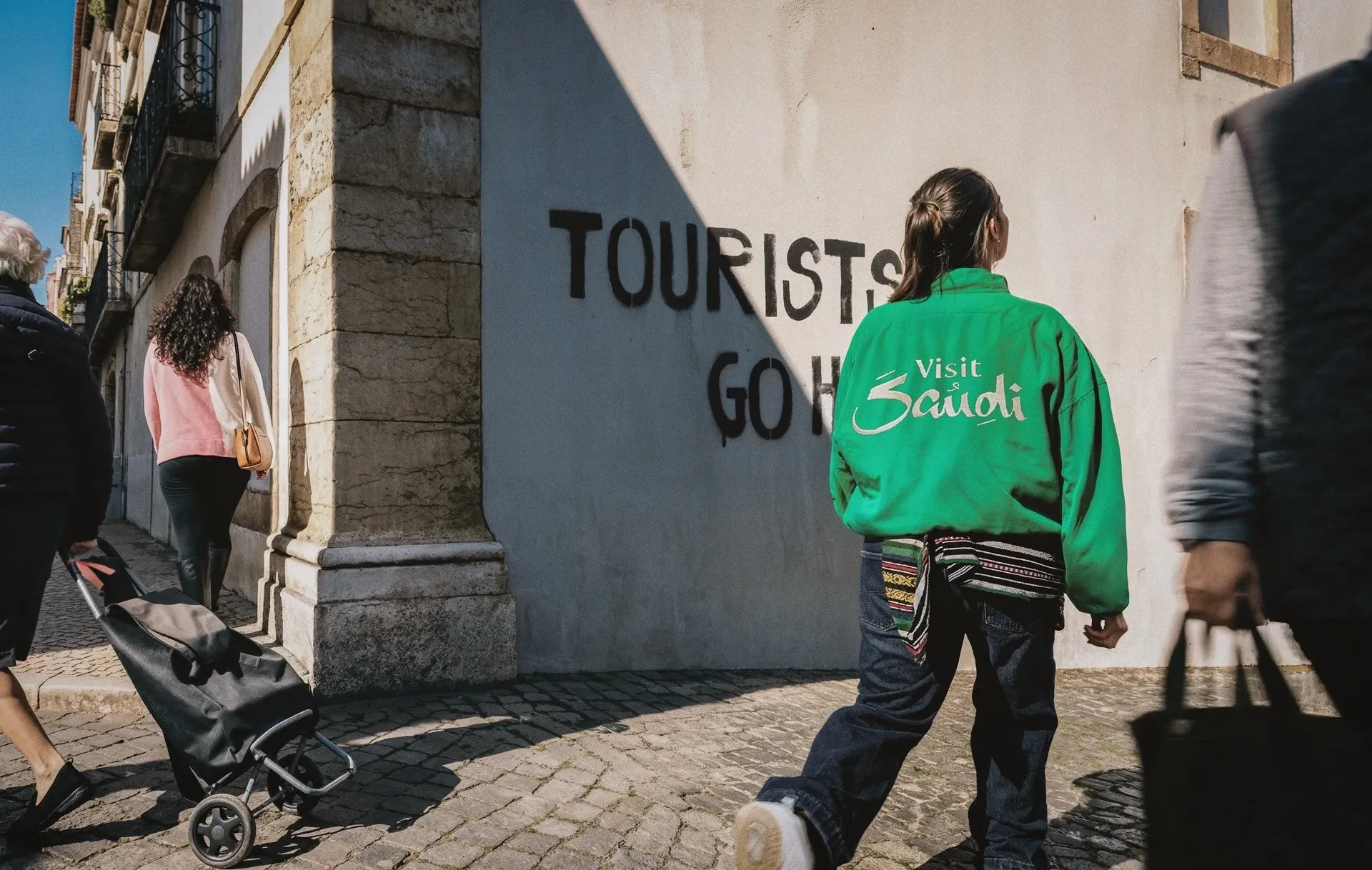
Models wearing "Visit Saudi" branded apparel, a green jersey and a burgundy bomber jacket among the pieces shown, were photographed and filmed standing directly in front of unaltered "Tourists Go Home" graffiti in Barcelona, Lisbon and Rome. Executive Creative Director Ciaran Bonass was explicit on this point: "The graffiti itself is real, well-documented, and was already there. It wasn't created or commissioned by the campaign."
That distinction matters for how the work should be read. This was not a physical wildposting takeover of protest sites. It was a photographic and video intervention staged at real locations, built for distribution as content rather than as permanent out-of-home.
The Execution
The production carried the polish of a fashion shoot rather than a guerrilla stunt: Fadi Mroue as CCO, Bonass as ECD, a Brazil-based creative and production team (Glauber Dorotheu and Leo Razera as ACDs, Stefano Chiabrando on art direction, Johan Granados on copy, Nixon Freire behind the camera) working through production house The Producer. The apparel functioned as the campaign's only real media unit. Everything else, the wall, the slogan, the street, was found rather than built.
The Distribution
The work surfaced first through advertising trade press, Clube de Criação in Brazil on September 1 and Communicate Online in the Gulf on September 10, before reaching wider regional coverage through Campaign Middle East. That sequencing is worth noting on its own terms: the initial audience for this campaign was other marketers and creative directors before it was European travelers.
That is not unusual for guerrilla work built to travel on earned media rather than paid reach, but it does mean the campaign's first job was reputation inside the industry, and its second job is redirecting actual trip decisions. Those are different audiences with different definitions of success.
The Results
None are public. Bonass's own framing, monitoring earned media, engagement and sentiment rather than "declaring victory early", is itself a tell that no conversion, booking or search-intent data was available at launch. Reach through trade coverage is real and measurable. Whether a single trip got rerouted from Barcelona to AlUla because of it is not something this campaign has shown, and it should not be credited with that until it does.
The SOOGK Take
The creative logic is sound. SRMG Labs correctly read that Europe's overtourism backlash was already a media event, not a private grievance, and treated it as available raw material instead of a story to stay away from. Standing next to someone else's rejection message and offering an alternative is cheaper and more credible than building a new argument from nothing, because the audience supplies half the meaning themselves.
The honest tension sits one level down. The protests behind this graffiti are about housing costs and displacement, a resident's argument with their own city, not a comparison shopping decision between Barcelona and AlUla. Repurposing that message for a national tourism board carries a real risk of reading as opportunistic rather than clever, even when the execution is careful not to fabricate or exaggerate the source material. The campaign has not faced that criticism publicly yet, but it is early, and the distribution so far has been almost entirely friendly trade press rather than European consumer or cultural commentary.
There is also a quieter mismatch worth naming. This campaign asks a European leisure traveler to redirect toward Saudi Arabia in the same year Saudi Arabia's own international leisure arrivals dipped and its inbound mix still leans heavily on religious and domestic travel rather than discretionary leisure. Attention-generation and demand-conversion are different problems, and this campaign has, so far, only demonstrated the first one.
The transferable lesson isn't "hijack a protest." It's narrower than that: a competitor's negative narrative becomes usable creative material only when the alternative you're offering resolves the exact tension the negative narrative created, not just its aesthetic. "You're not welcome here" and "you're welcome here" is a clean creative match. Whether it's a strategically sound one depends on whether the destination on the other side of the wall can actually deliver on the invitation. That part still has to be earned after the photo runs, not during it.
Figures on Saudi Arabia's visitor numbers and 2030 target are drawn from Ministry of Tourism data as reported by Arab News, Skift, Economy Middle East and Gulf News. Q1 2026 inbound decline figures are from Ministry of Tourism data reported by Cavendish Maxwell. Campaign production credits and the Bonass quote are drawn from Communicate Online and Clube de Criação's coverage of the campaign.
Sources
- Saudi Tourism Authority, SRMG hijack "Tourist Go Home" protest in Europe with perfect response — Campaign Middle East
- Saudi Tourism Just Hijacked Europe's Anti-Tourist Graffiti, and Turned It Into an Invitation — Communicate Online
- Tourists Go Visit Saudi — Clube de Criação
- 'Gringos leave': Protests targeting travelers rise as overtourism anger grows — CNBC
- Barcelona Makes Its Feelings Clear, Not One Tourist More — Forbes
- Saudi Arabia attracts 122 million tourists, pumping SR300 billion into national economy in 2025 — Gulf News
- Saudi Arabia On Track To Hit 2030 150 Million Visitor Goal — Skift
- Saudi Tourism 2026: Inbound Visitors Fell 13% — Vision2030.ai


